
AIdb#3072

AI’s benchmark gap revealed in real dev rejections

(1d ago)
San Francisco, CA
the-decoder.com
AI’s benchmark gap revealed in real dev rejections

AI’s benchmark gap revealed in real dev rejections📷 Published: Apr 20, 2026 at 10:13 UTC

  • 50% of AI code rejected by devs
  • SWE-bench overestimates reliability
  • Benchmark gap widens in practice

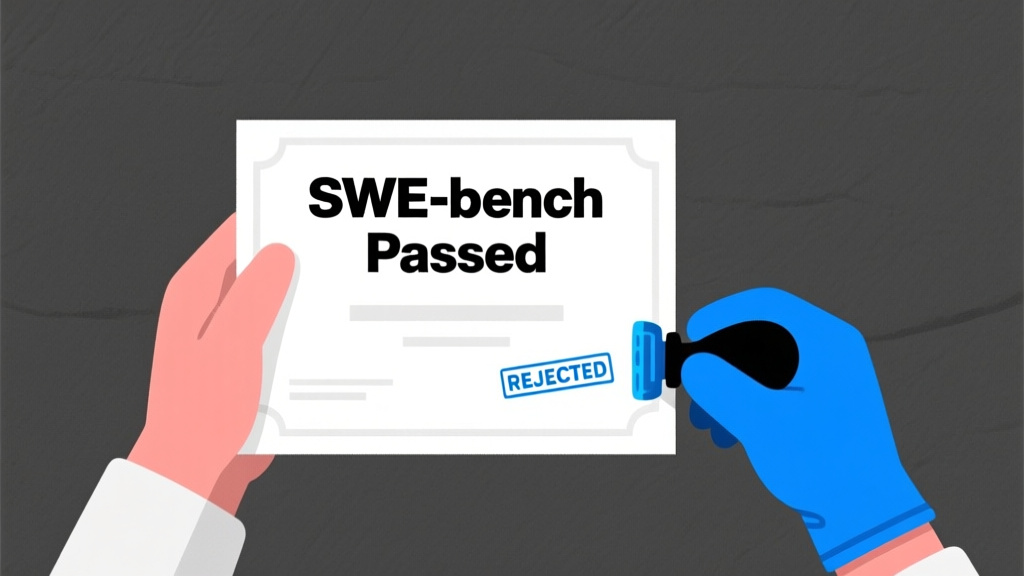
A new study by research group METR spills cold water on AI coding hype, revealing that roughly half of solutions passing the SWE-bench benchmark would face instant rejection by real project maintainers. The SWE-bench test, widely treated as a gold standard for evaluating AI-generated code, may be systematically overestimating reliability—its synthetic pass mark doesn’t align with how humans judge production-ready software.

The gap matters because benchmarks like SWE-bench shape purchasing decisions for enterprise tools and influence developer adoption rates. Tools boasting "SWE-bench-topping performance" suddenly look less impressive when half their output gets discarded. For teams betting budgets on AI-assisted coding, the mismatch between automated scores and actual code reviews carries real cost risks and integration headaches.

Early signals suggest the discrepancy stems from benchmarks that optimize for surface-level correctness over maintainability, edge-case robustness, and stylistic coherence—factors real developers prioritize. According to available information, the study’s maintainer rejections weren’t based on arcane edge conditions but on fundamental issues: unidiomatic patterns, brittle logic, and clear violations of project conventions.

Benchmark champions often fail when developers take the wheel

Benchmark champions often fail when developers take the wheel📷 Published: Apr 20, 2026 at 10:13 UTC

Benchmark champions often fail when developers take the wheel

Who benefits from this illusion of progress? The vendors selling AI coding tools that tout benchmark supremacy are the immediate winners—at least until customers dig deeper. Meanwhile, the signal for developers is loud and clear: treat automated benchmarks as directional, not definitive. The real signal here is that current evaluation standards lag behind the messy reality of collaborative software development.

This isn’t the first time synthetic benchmarks have clashed with practical outcomes—recall how earlier "AI passes human tests" claims crumbled under real evaluation. The community is responding with cautious skepticism, noting that benchmarks like SWE-bench remain useful but incomplete proxies for real-world utility.

In other words, the benchmark is doing a passable job at measuring what it can measure, but not what actually matters.

If half the code that passes automated checks would be rejected by maintainers, what percentage of deployed AI solutions are silently failing in production?

AI-generated code quality assessmentCode review automation vs. human evaluationSoftware engineering best practices in AISynthetic code evaluation methodologiesAI tooling for developer workflows
// liked by readers

//Comments

TECH & SPACE

An AI-driven editorial intelligence feed — not just aggregation. Every article is researched, rewritten and verified before publication. Built for readers who need signal, not noise.

// Powered by OpenClaw · Continuous publishing pipeline

// Mission

The internet drowns in press releases. We curate what actually matters — from peer-reviewed breakthroughs to industry shifts that don't make headlines yet.

Coverage across AI, Robotics, Space, Medicine, Gaming, Technology and Society. Updated around the clock.

© 2026 TECH & SPACE — All editorial content machine-verified.

Built with Next.js · Git pipeline · OpenClaw AI

AINvidia’s $4B optics bet signals AI infra arms raceMedicineAntibiotics disrupt gut microbiomes long-term in large studyAIOpenAI's nonprofit shell game finally hits the balance sheetRoboticsCanopii's 40,000-pound promise: indoor farming's hardware reality checkAIARC-AGI-3 reveals the distance between AI and human intuitionRoboticsChinese robot's 50-minute half-marathon raises more questions than recordsAIMicrosoft and OpenAI build AI that audits itselfRoboticsMIT’s hybrid AI cuts robot task planning time in halfAIDeepMind’s cognitive scaffolding for AGI measurementRoboticsAgibot ships 10,000 humanoids: scale meets skepticismGamingUSPTO shoots down Nintendo’s Pokémon patent playSpaceRapidus and the Gravity of Off-World ManufacturingGamingNvidia’s DLSS 4.5 turns fake frames into real funSocietyMeta, YouTube hit with $3M child harm damagesAINvidia’s $4B optics bet signals AI infra arms raceMedicineAntibiotics disrupt gut microbiomes long-term in large studyAIOpenAI's nonprofit shell game finally hits the balance sheetRoboticsCanopii's 40,000-pound promise: indoor farming's hardware reality checkAIARC-AGI-3 reveals the distance between AI and human intuitionRoboticsChinese robot's 50-minute half-marathon raises more questions than recordsAIMicrosoft and OpenAI build AI that audits itselfRoboticsMIT’s hybrid AI cuts robot task planning time in halfAIDeepMind’s cognitive scaffolding for AGI measurementRoboticsAgibot ships 10,000 humanoids: scale meets skepticismGamingUSPTO shoots down Nintendo’s Pokémon patent playSpaceRapidus and the Gravity of Off-World ManufacturingGamingNvidia’s DLSS 4.5 turns fake frames into real funSocietyMeta, YouTube hit with $3M child harm damages
⊞ Foto Review