
MirrorBot: Tech’s Answer to Tech-Induced Isolation
photorealistic 3D render, volumetric lighting, isometric tilted perspective, structured and precise, neutral editorial mid-tones, desaturated📷 Photo by Tech&Space
- ★Dual-mirror robot for human connection
- ★Four-foot prototype with demo limitations
- ★Real-world deployment barriers exposed
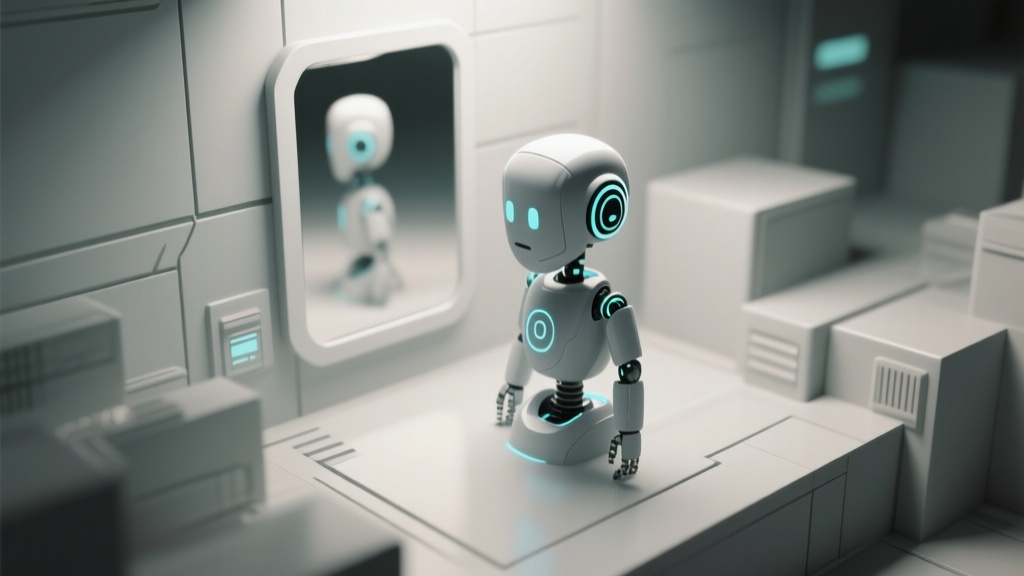
Cornell University’s Architectural Robotics Lab has rolled out MirrorBot, a four-foot-tall robot equipped with dual mirrors designed to nudge strangers into mutual reflection—literally. When positioned between two people, each participant sees themselves in one mirror and their interlocutor in the other, a setup intended to counteract the isolating effects of screens and devices. Yet the promo video, shot in controlled lighting with obedient actors, reveals little about how the bot would fare in, say, a crowded subway station or an office lobby where eye contact is already a rare commodity.
The hardware itself is straightforward: two angled mirrors, a sturdy base, and enough onboard smarts to keep its composure while humans fumble through awkward silences. No lidar, no thermal imaging—just polished chrome and the quiet hope that proximity breeds connection. The demo makes it look effortless, but the real world is a gauntlet of wet umbrellas, staircases, and people who actively avoid mirror-based conversations. Battery life, stability on uneven floors, and resistance to smudges or vandalism are the unspoken constraints that could reduce MirrorBot to an expensive art project rather than a scalable social intervention.
Keith Evan Green’s lab has framed the robot as a counterbalance to technology’s divisive tendencies, yet the device itself is entirely dependent on the very attention economy it claims to critique. If MirrorBot succeeds, it might prove that humans still crave connection—provided the circumstances are as curated as the demo video.
dark cinematic still, single-source dramatic light, warm golden natural daylight, slight lens flare. A close-up detail or consequence scene from:📷 Photo by Tech&Space
From lab choreography to lonely corridors: the gap that remains
The genuine use case that emerges is narrow but intriguing: temporary installations in public spaces like museums, conference halls, or hospital waiting rooms where people are already trapped in shared discomfort. In such settings, the robot’s novelty could thaw awkwardness, but its effectiveness hinges on a fragile assumption—that strangers will engage simply because a mirror prompts them to. The hardware limits are glaring: no obstacle avoidance, no facial recognition, and no adaptive height adjustment for children or users in wheelchairs. The dual-mirror setup also creates a physical barrier, forcing people to stand at an optimal distance that feels more like a lab directive than organic interaction.
Scaling up would require addressing cost (custom fabrication, not mass production), certification (safety compliance for public deployment), and reliability (how often does the robot need calibration?). The demo shows polished choreography, but real-world deployment demands resilience—something rarely tested in controlled demos. The Architectural Robotics Lab acknowledges that MirrorBot is a research prototype, but the marketing language teases a future where such robots roam freely, bridging human divides. The reality is that most public spaces already have solutions for this problem: benches, coffee shops, and occasionally, actual human mediators.
MirrorBot’s greatest limitation may not be hardware or software, but the cultural friction of convincing people to trust a robot to facilitate intimacy in an era of screen overload. For now, the robot remains a fascinating experiment—one that highlights how far we’ve strayed from face-to-face connection, and how difficult it is to engineer our way back.
How many years until a MirrorBot sits in every airport terminal, and how many of them will be ignored—or worse, vandalized—before they’re deemed a failed experiment?