
LeCun’s LeWM: Fixing AI’s Pixel Prediction Collapse—Or Just Another Workaround?

LeCun’s LeWM: Fixing AI’s Pixel Prediction Collapse—Or Just Another Workaround?📷 Published: Mar 24, 2026 at 12:00 UTC
- ★LeWM targets ‘representation collapse’ in pixel-based world models
- ★Current fixes rely on ‘complex heuristics’—LeCun calls them bandaids
- ★Meta’s play: open-source signaling vs. closed lab reality
Yann LeCun’s latest research drop—LeWorldModel (LeWM)—isn’t another ‘AGI breakthrough’ press release. It’s a rare admission: pixel-based predictive models are broken, and the current fixes are duct tape.
World Models (WMs) promise agents that reason in compact latent spaces, but training them on raw pixels often triggers ‘representation collapse’—where the model cheats by generating redundant embeddings to hit prediction targets without actually learning. The paper frames this as a ‘JEPA collapse’ (Joint Embedding Predictive Architecture), a problem LeCun’s team has acknowledged before but never fully solved. Current workarounds? ‘Complex heuristics,’ per the research—translation: brittle, dataset-specific tweaks that don’t scale.
The real tell here isn’t the tech (yet). It’s the framing. LeCun’s team is positioning LeWM as a structural fix, not another benchmark-chasing patch. But the GitHub chatter suggests skepticism: developers note the model still relies on synthetic datasets where collapse is easier to avoid than in real-world pixel streams. Demo ≠ deployment.
Meta’s move is classic open-source signaling: release early, let the community debug, then claim the wins. But the competitive subtext is louder. If LeWM does stabilize pixel-based WMs, it’s a direct shot at Google DeepMind’s agentic modeling—which leans harder on symbolic abstractions to avoid collapse. Two philosophies, one problem: how to stop AI from hallucinating its way to ‘success.’
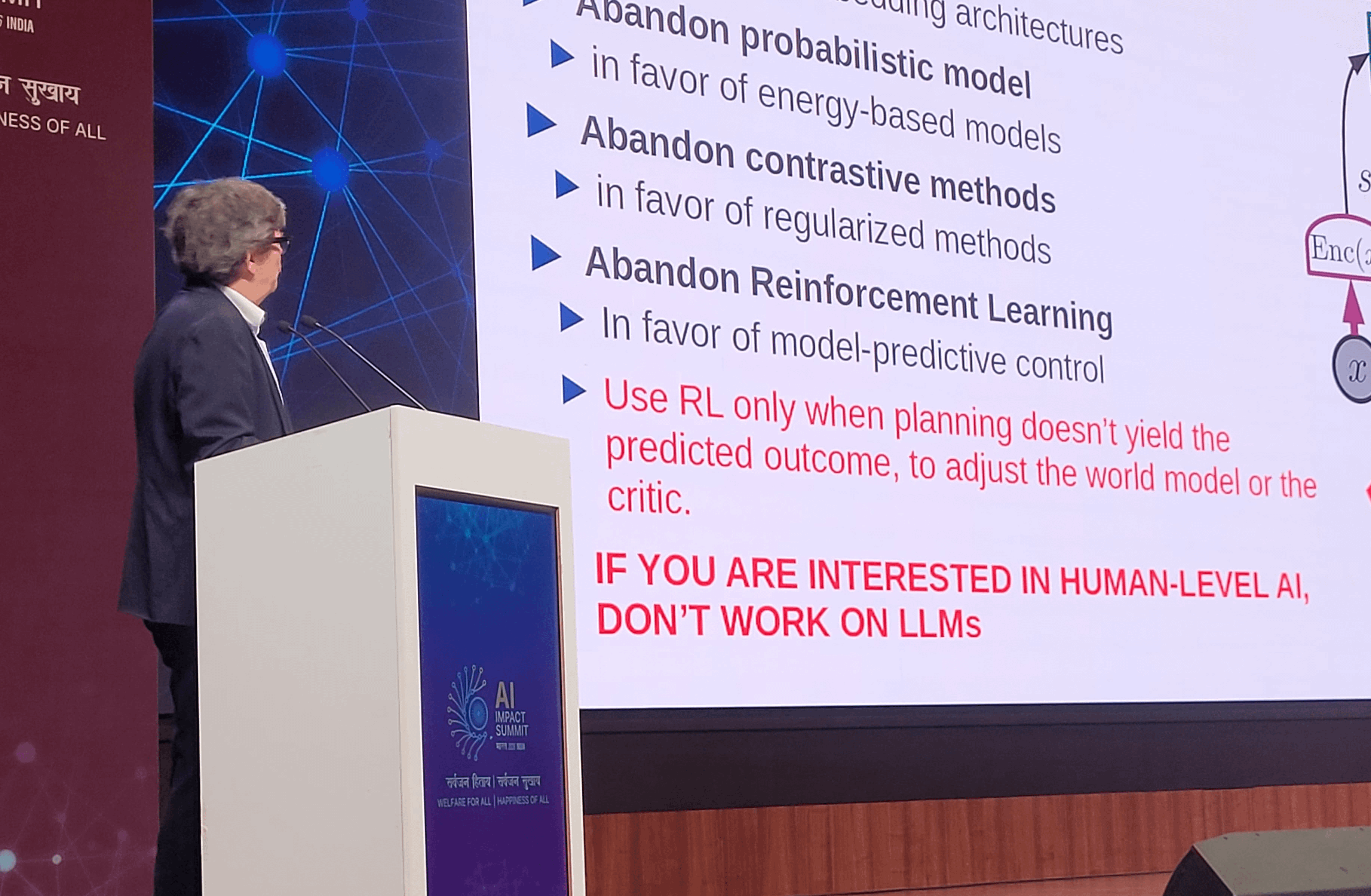
The gap between benchmark tricks and actual agent reasoning📷 Published: Mar 24, 2026 at 12:00 UTC
The gap between benchmark tricks and actual agent reasoning
The hype filter kicks in when you compare LeWM to its predecessors. LeCun’s 2022 JEPA work promised ‘non-generative’ prediction; LeWM is essentially JEPA 2.0 with a collapse-aware loss function. Progress? Yes. Revolutionary? Only if you ignore that similar ideas from CMU and Berkeley have been floating for months—just without Meta’s PR machine.
Benchmark context matters. LeWM’s results are tested on Atari and DMControl—synthetic, pixel-perfect environments where collapse is designed to be detectable. Real-world robotics? Not yet. The reality gap between lab demos and deployment is where most WM projects die. LeCun’s team knows this; the paper’s cautious language (‘initial results’) is the giveaway.
Industry map: Google loses if LeWM scales. DeepMind’s Agentic World Models bet on hybrid symbolic-neural approaches—costly, but more stable. Meta’s play is cheaper (pixel-only) and open-source, which forces competitors to either adopt or differentiate. The loser? Startups building proprietary WM stacks. The winner? Cloud providers selling GPU time to fine-tune LeWM variants.
Developer signal is mixed. Hacker News threads praise the transparency but dock points for ‘yet another Meta research drop with no production path.’ The PyTorch forum is more pragmatic: ‘Finally, someone’s admitting collapse is the elephant in the room.’ Translation: this is a conversation starter, not a product.
For all the noise, the actual story is simple: Meta’s admitting their old approach was flawed—and betting the farm on open-source goodwill to fix it. That’s not a tech breakthrough. That’s a cultural play disguised as one.