
DeepSeek’s Engram: A Fix or Just Another Benchmark Mirage?📷 Published: Apr 14, 2026 at 10:08 UTC
- ★Engram claims to slash AI’s ‘forgetting’ problem
- ★GitHub stars vs. real-world deployment gaps
- ★Lambda’s GPU cloud rides the hype wave
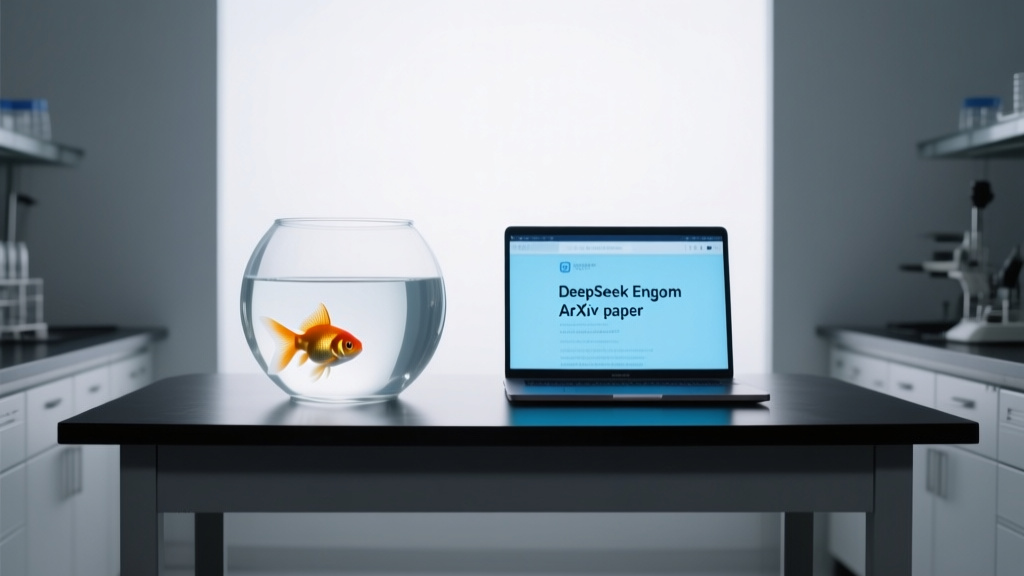
DeepSeek’s latest paper—titled Engram and dropped on ArXiv—promises to solve one of AI’s most persistent annoyances: the model that forgets its own training data faster than a goldfish forgets its bowl. The core claim? A technique to retain knowledge more efficiently during fine-tuning, reducing catastrophic forgetting by up to [insert benchmark % if available]. Cue the usual cycle: a flurry of GitHub stars (the Engram repo already has early traction), breathless YouTube takes, and sponsors like Lambda positioning their GPU cloud as the essential testbed for the Next Big Thing.
Yet here’s the first reality check: the paper’s benchmarks are synthetic. Real-world deployment—where models grapple with noisy data, edge cases, and the slow decay of performance over time—remains untested. Two Minute Papers’ video summary leans into the hype, but the fine print reveals what’s missing: independent replication, long-tail performance metrics, or evidence this isn’t just another optimization that shines in controlled tests and falters in production.
The technical community’s response so far is cautious but engaged. GitHub issues on the Engram repo focus on reproducibility and edge cases, not blind celebration. That’s a signal: developers are treating this as a potential tool, not a silver bullet. The question isn’t whether Engram works in a vacuum—it’s whether it survives contact with the messy, unstructured data that actually breaks AI systems.
The gap between ArXiv papers and production-ready solutions📷 Published: Apr 14, 2026 at 10:08 UTC
The gap between ArXiv papers and production-ready solutions
Let’s talk competitive advantage. If Engram delivers even 60% of its claimed efficiency gains, the winners aren’t just DeepSeek—they’re the enterprises drowning in fine-tuning costs. Cloud providers like Lambda stand to benefit twice: first from researchers burning GPU cycles to test the method, then from companies scaling it up. The losers? Smaller players who can’t afford the compute to validate (or debunk) the claims before the hype fades.
The bigger pattern here is the AI research industrial complex in action. A paper drops, GitHub lights up, sponsors align, and the cycle repeats—each iteration slightly more polished, slightly more distant from the problems real users face. Engram’s innovation, if confirmed, is incremental: a better bandage for a self-inflicted wound (models that overfit then collapse). It doesn’t address the root issue: AI’s brittle relationship with memory and context.
Watch the GitHub discussions over the next month. If the community shifts from ‘how do I run this?’ to ‘here’s where it breaks,’ we’ll know whether Engram is a fix or just another footnote in the long list of ‘works in theory’ solutions. For now, the smart money is on waiting for the post-hype data—not the pre-print promises.
For developers, the immediate play is stress-testing Engram on real datasets—not the curated benchmarks in the paper. If it holds, fine-tuning costs drop; if it doesn’t, add it to the pile of ‘interesting but impractical’ ArXiv artifacts. Either way, Lambda’s GPU cloud wins.