
US export bans fail as PLA-linked labs get Nvidia AI chips
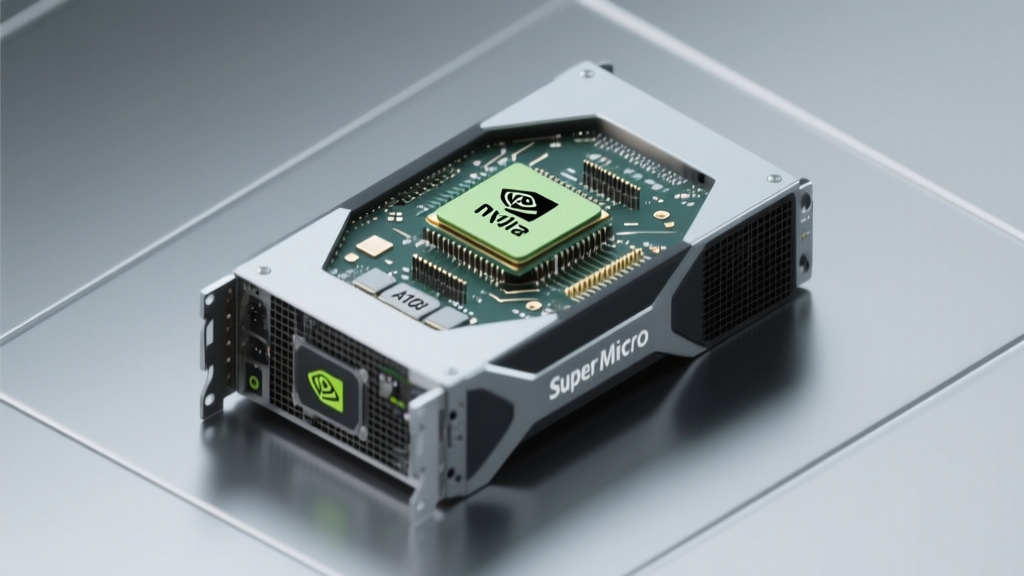
A stylized 3D rendering of a single Super Micro server with Nvidia A100 AI chips, set in a neutral grey and brushed aluminium environment, with📷 Photo by Tech&Space
- ★PLA-affiliated universities evade US sanctions
- ★Super Micro servers shipped with Nvidia A100s in 2025–2026
- ★Export controls bypassed through academic loopholes
Four Chinese universities, including two directly linked to the People’s Liberation Army, acquired Super Micro servers packed with Nvidia A100 AI chips in 2025 and 2026—years after the US Commerce Department blacklisted the hardware. Public procurement documents, first reported by Tom’s Hardware, reveal that the purchases were completed despite stringent export controls designed to cripple China’s military AI capabilities. The A100, a flagship data-center accelerator, was explicitly banned for sale to Chinese entities in 2022, yet the chips still found their way into PLA-affiliated research labs under the guise of academic work.
Super Micro, a California-based manufacturer, appears to have fulfilled the orders through indirect channels, underscoring a recurring weakness in the US export regime: enforcement relies on self-reporting and voluntary compliance by intermediaries. The universities in question—National University of Defense Technology and Harbin Institute of Technology—are sanctioned under the Entity List, yet the servers arrived with Nvidia silicon intact. For end users, this means the PLA’s AI development pipeline remains operational, with access to cutting-edge training hardware that rivals the best US labs can field.
US export bans fail as PLA-linked labs get Nvidia AI chips📷 Photo by Tech&Space
The gap between policy and enforcement is wide enough to drive a server rack through
The implications stretch beyond geopolitics. US cloud providers and enterprise customers who legally purchased A100s are now competing against sanctioned entities that obtained identical hardware at likely lower cost—thanks to state subsidies and procurement loopholes. Meanwhile, Nvidia’s next-generation H200 chips, slated for release later this year, face even tighter scrutiny, raising questions about how long the cat-and-mouse game can continue before either side blinks.
For developers and researchers outside China, the episode reveals a frustrating asymmetry: while US firms navigate a labyrinth of compliance paperwork, PLA-linked teams appear to operate with near impunity. The downstream effect is a distorted market where sanctioned AI chips are deployed in military research, scrambling the competitive landscape for legitimate users. Cloud providers like AWS and Google Cloud, which rely on Nvidia’s latest silicon, may soon face pressure to audit their supply chains more aggressively—adding another layer of cost and complexity to already strained workflows.
The real signal here is not that export controls are porous—that much was known—but that the enforcement gap is expanding precisely when the stakes are highest. As AI models grow larger and more capable, every illicit A100 in PLA hands translates to a tangible advantage in everything from autonomous weapons to cyber warfare. For the US tech industry, the takeaway is clear: compliance is no longer optional, but a strategic imperative.