
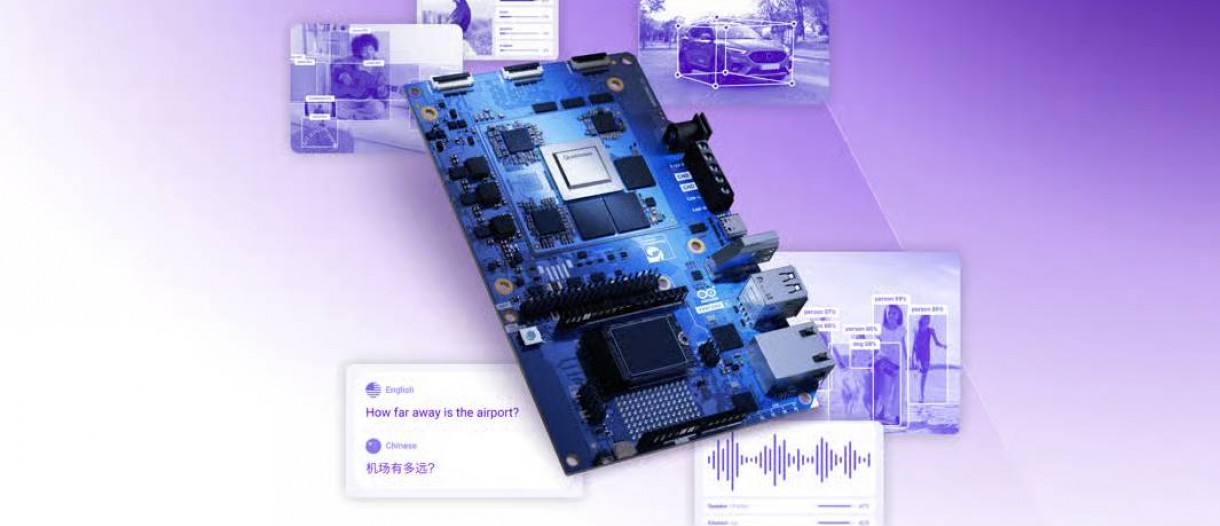
Arduino’s Ventuno Q: AI brains for real robotics📷 Published: Apr 21, 2026 at 18:05 UTC
- ★Dragonwing IQ-8275 powers 40 TOPS AI
- ★Uno Q proves Linux-ready but limited
- ★From lab toy to deployment reality
Qualcomm unleashed its Dragonwing IQ-8275 into Arduino’s Ventuno Q, turning a tinkerer’s board into a 40 TOPS AI powerhouse Arduino’s Uno Q already proved Linux could run on these devices. Last year’s acquisition by Qualcomm meant the Uno Q arrived as a stepping stone—capable but modest, with a quad-core Cortex-A53 and shared 4GB RAM. The Ventuno Q, however, strips all pretense of hobbyist constraints.
Early signals suggest the Dragonwing chip delivers the muscle needed for edge AI, robotics, and security workloads that once required server racks. Unlike its predecessor, this board isn’t just proving concepts—it’s built for the gritty reality of deployment in industrial cages, warehouse aisles, or outdoor sensor nodes. The 40 TOPS figure isn’t marketing fluff; it’s a threshold where vision models, predictive maintenance, and simple robot pathing can run without cloud latency.
The AI SBC that demands more than a demo bench📷 Published: Apr 21, 2026 at 18:05 UTC
The AI SBC that demands more than a demo bench
But hardware muscle isn’t strategy. The real barrier is integration: wiring power budgets, thermal design, and real-time OS support in a package smaller than a deck of cards. Community responses already flag the Ventuno Q’s appetite for robust cooling—something CSV demos rarely show early stress tests reveal thermal throttling under sustained AI loads. Deploy this in a dusty factory floor or a solar-powered weather station, and suddenly the demo collapses if the enclosure lacks airflow.
Industrial adopters won’t gamble on promises. They’ll need certified power profiles, vendor-backed real-time kernels, and a stack of libraries that survive OS updates. Until then, the Ventuno Q remains a brilliant lab tool—one that makes engineers salivate but operations managers pause.
The Ventuno Q’s true signal is the shift from AI curiosity to industrial necessity. If Qualcomm and Arduino can guarantee thermal stability and OS longevity, we’re looking at a platform that turns prototype robotics into productized automation overnight.