
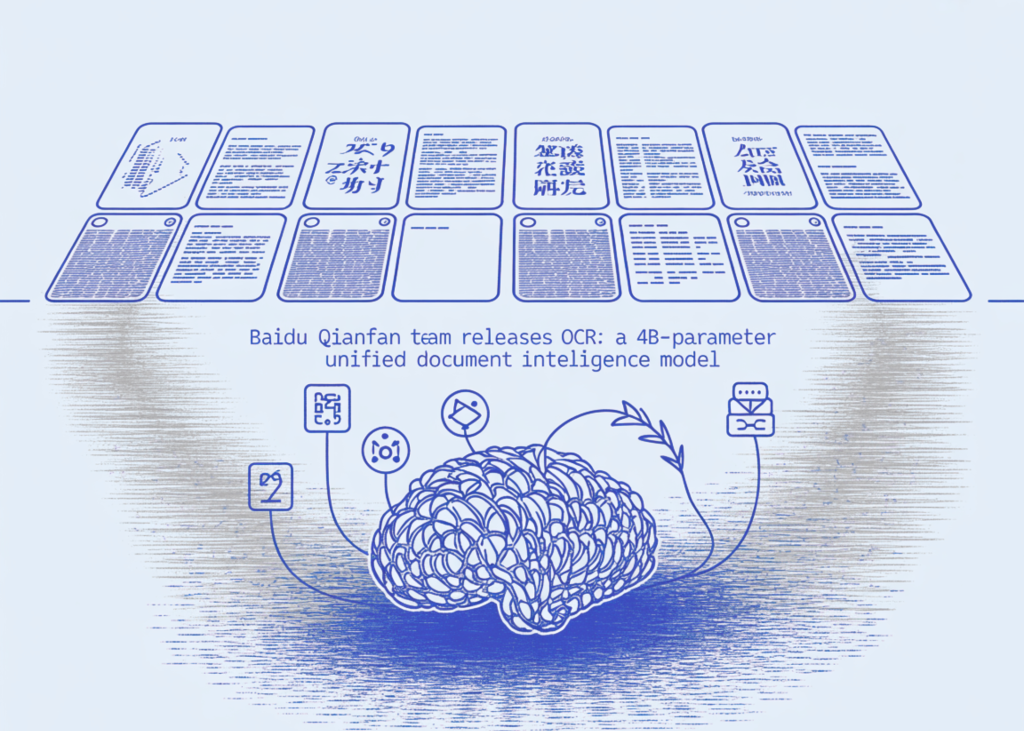
Baidu’s 4B OCR marries vision and language📷 Published: Apr 18, 2026 at 10:21 UTC
- ★Vision-language model skips OCR’s modular mess
- ★End-to-end image-to-Markdown conversion
- ★Prompt-driven table QA joins core features
Baidu’s Qianfan team just dropped a 4-billion-parameter model that collapses layout analysis, text recognition, and document understanding into one end-to-end vision-language stack. Most OCR still runs through brittle, multi-stage pipelines that chain detection, recognition, and parsing modules like so many rusty pipe couplings. Qianfan-OCR slices the Gordian knot by pushing the entire workflow straight from pixels to Markdown. The headline stat—4B parameters—sounds like marketing math until you remember that 4 billion transformer weights actually buy a shared understanding of shapes, text, and structure at once.
Prompt-driven features are the real surprise. On top of raw OCR, the stack accepts instructions for table extraction and document Q&A, turning a static page into a queryable knowledge graph. Early demos show it handling two-column PDFs and nested tables without a hiccup, something that routinely trips modular OCR systems. According to Baidu’s release notes, the model claims up to 6% accuracy lifts on public benchmarks versus a state-of-the-art two-stage pipeline. Whether those numbers survive real-world filing cabinets remains to be seen.
One architecture, zero glue-code overhead📷 Published: Apr 18, 2026 at 10:21 UTC
One architecture, zero glue-code overhead
What gives this launch teeth is the direct image-to-Markdown conversion. Traditionally, OCR pipelines export plain text or messy HTML; downstream apps then wrestle with layout metadata. Qianfan-OCR bakes formatting awareness into its decoder, so a scanned resume spits out clean markdown that renders identically on GitHub, Obsidian, or a blog engine. On the dev side, Baidu wraps the model behind an open-source SDK and a cloud API, giving startups a one-click upgrade path from legacy Tesseract setups.
The hype filter is still on: Baidu hasn’t revealed latency figures for the 4B model running on consumer GPUs, and prompt-based table QA feels familiar from other multimodal launches. Yet the architectural promise is real—fewer moving parts mean fewer failure points, lower maintenance, and faster time-to-insight. For cloud vendors selling document AI, Qianfan-OCR removes a major upgrade friction point, nudging the entire market toward end-to-end stacks.
The real signal here is the dev comfort. A single API call that turns messy scans into usable markdown removes an entire class of integration headaches for startups shipping document automation.