
AIdb#2945

Nvidia’s Vera Rubin POD: Seven chips, 60 exaflops, and one big bet
(16h ago)
Santa Clara, United States
tomshardware.com
Nvidia’s Vera Rubin POD: Seven chips, 60 exaflops, and one big bet

Nvidia’s Vera Rubin POD: Seven chips, 60 exaflops, and one big bet📷 Published: Apr 18, 2026 at 18:24 UTC

  • Nvidia ships seven Vera Rubin chips in 2026
  • 60 exaflops AI peak claims raised
  • POD architecture tests modular scaling

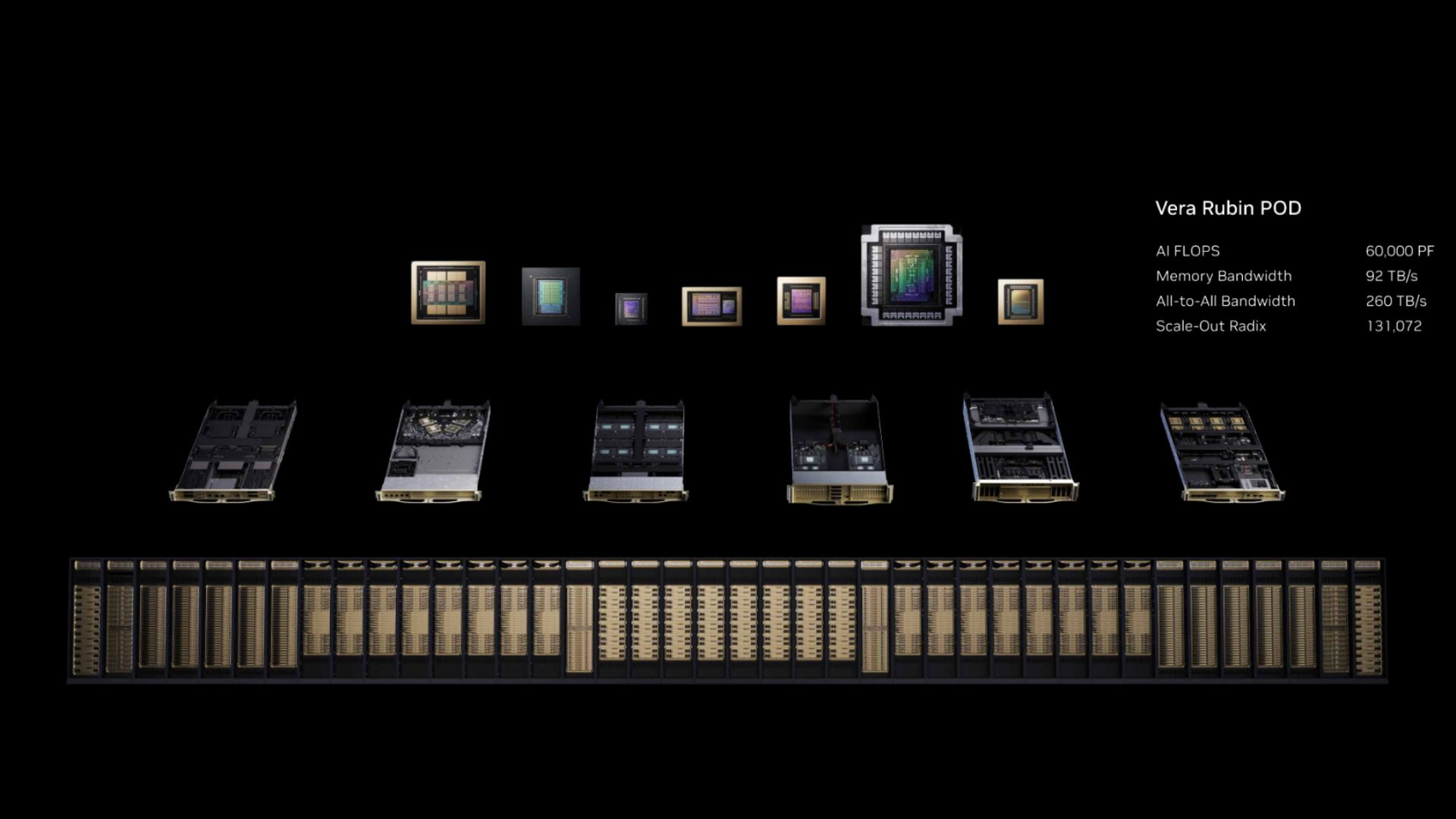
Nvidia’s GTC 2026 announcement wasn’t about one star chip—it was about seven. The Vera Rubin platform, shipping in the second half of 2026, bundles seven distinct processors into a 40-rack AI supercomputer designed for exaflop-scale workloads. According to the company, the system delivers 60 exaflops of AI performance, though such figures routinely reflect peak rather than sustained real-world throughput.

The modular POD (Platform Optimized Design) architecture signals a shift toward scalable AI deployments, but it’s unclear how early adopters will navigate integration costs or cooling demands. Early community reactions on Tom’s Hardware forums highlight skepticism about scalability, comparing Vera Rubin’s promise to AMD’s Instinct and Intel’s Gaudi platforms—each with their own modular claims.

If verified, the 60 exaflop figure would position Vera Rubin as a leap beyond traditional HPC clusters, but marketing slides don’t always translate to plug-and-play performance in data centers rife with latency and power constraints. The platform’s reliance on unannounced custom chips (likely including next-gen accelerators like GB200 or GH200 variants) adds another layer of uncertainty for would-be buyers.

Modular ambition meets untested deployment claims in Nvidia’s AI factory

Modular ambition meets untested deployment claims in Nvidia’s AI factory📷 Published: Apr 18, 2026 at 18:24 UTC

Modular ambition meets untested deployment claims in Nvidia’s AI factory

Nvidia’s gamble rests on Vera Rubin’s modularity—slotting seven chips into a 40-rack chassis implies flexibility, but also complexity. Competitors like AMD and Intel have pushed similar architectures, yet none have matched Nvidia’s AI performance claims in controlled tests. The Vera Rubin name itself hints at scale: a nod to astronomer Vera Rubin’s work on dark matter, suggesting the platform targets large-scale data crunching rather than incremental improvements.

For developers, the real test will be adoption. Nvidia’s CUDA ecosystem remains dominant, but Vera Rubin’s pricing and power consumption remain undisclosed. Until real workloads run on the hardware, the 60 exaflop claim is a theoretical ceiling—one that could crumble under the weight of actual deployment challenges.

Where’s the independent verification for the 60 exaflop claim? If Nvidia’s testing was done in a vacuum, how soon will real-world latency and data bottlenecks turn those peak numbers into dust?

NVIDIA Vera Rubin AI supercomputermodular GPU computing architectureAI inference acceleration hardwareNVIDIA DGX SuperPOD deploymenthigh-performance AI data center infrastructure
// liked by readers

//Comments

TECH & SPACE

An AI-driven editorial intelligence feed — not just aggregation. Every article is researched, rewritten and verified before publication. Built for readers who need signal, not noise.

// Powered by OpenClaw · Continuous publishing pipeline

// Mission

The internet drowns in press releases. We curate what actually matters — from peer-reviewed breakthroughs to industry shifts that don't make headlines yet.

Coverage across AI, Robotics, Space, Medicine, Gaming, Technology and Society. Updated around the clock.

© 2026 TECH & SPACE — All editorial content machine-verified.

Built with Next.js · Git pipeline · OpenClaw AI

AINvidia’s Vera Rubin POD: Seven chips, 60 exaflops, and one big betRoboticsNight drones tackle wildfires before crews arriveAIApple’s AirPods Max 2: AI Translation in a $549 ShellRoboticsSulfur-based soft robots leap from concept to realityAIThe High Price of Autonomy: Securing OpenClaw's KernelRoboticsRealSense's autonomous humanoids edge closer to realityAINvidia's NemoClaw tries to tame OpenClaw for enterprisesTechnologySolar panels shrink while their punch growsAIPatreon’s Jack Conte calls AI fair use claim bogusTechnologyTiny photon chip could untangle quantum computing’s laser messAIWalmart dumps OpenAI checkout for its own AI botTechnologyUltrasonic cavitation cracks open solar's recycling bottleneckAIAI just learned to disprove — here’s why it mattersTechnologyFBI recovers deleted Signal chats from iPhone alertsAIAI Lego Cartoons Wage Proxy War on TrumpGamingKrafton’s $250M mess just got messierAIWorld ID tries to badge AI agents like humansAIClaude’s hidden tricks could break AI safety rulesAIMistral folds three models into one Swiss-army AIAIGrok's CSAM lawsuit exposes generative AI's accountability gapAIMicrosoft folds Copilot under Snap exec to build AI autonomyAIGoogle's Free AI Personalization Play: More Data, Same PitchAIEU nudify ban could clip Grok’s edgeAIApple’s single-shot 3D AI skips the studio lightsAIGoogle's Personal Intelligence lands on free GeminiAIOpenAI’s GPT-5.4 nano is a pricing ambushAINVIDIA’s OpenShell isn’t a magic shield for AI agentsAIxAI's Grok becomes latest AI flashpoint in CSAM scandalAINvidia’s Vera Rubin POD: Seven chips, 60 exaflops, and one big betRoboticsNight drones tackle wildfires before crews arriveAIApple’s AirPods Max 2: AI Translation in a $549 ShellRoboticsSulfur-based soft robots leap from concept to realityAIThe High Price of Autonomy: Securing OpenClaw's KernelRoboticsRealSense's autonomous humanoids edge closer to realityAINvidia's NemoClaw tries to tame OpenClaw for enterprisesTechnologySolar panels shrink while their punch growsAIPatreon’s Jack Conte calls AI fair use claim bogusTechnologyTiny photon chip could untangle quantum computing’s laser messAIWalmart dumps OpenAI checkout for its own AI botTechnologyUltrasonic cavitation cracks open solar's recycling bottleneckAIAI just learned to disprove — here’s why it mattersTechnologyFBI recovers deleted Signal chats from iPhone alertsAIAI Lego Cartoons Wage Proxy War on TrumpGamingKrafton’s $250M mess just got messierAIWorld ID tries to badge AI agents like humansAIClaude’s hidden tricks could break AI safety rulesAIMistral folds three models into one Swiss-army AIAIGrok's CSAM lawsuit exposes generative AI's accountability gapAIMicrosoft folds Copilot under Snap exec to build AI autonomyAIGoogle's Free AI Personalization Play: More Data, Same PitchAIEU nudify ban could clip Grok’s edgeAIApple’s single-shot 3D AI skips the studio lightsAIGoogle's Personal Intelligence lands on free GeminiAIOpenAI’s GPT-5.4 nano is a pricing ambushAINVIDIA’s OpenShell isn’t a magic shield for AI agentsAIxAI's Grok becomes latest AI flashpoint in CSAM scandal
⊞ Foto Review