
Unitree’s open-source robot data: Demo-grade or deployment-ready?
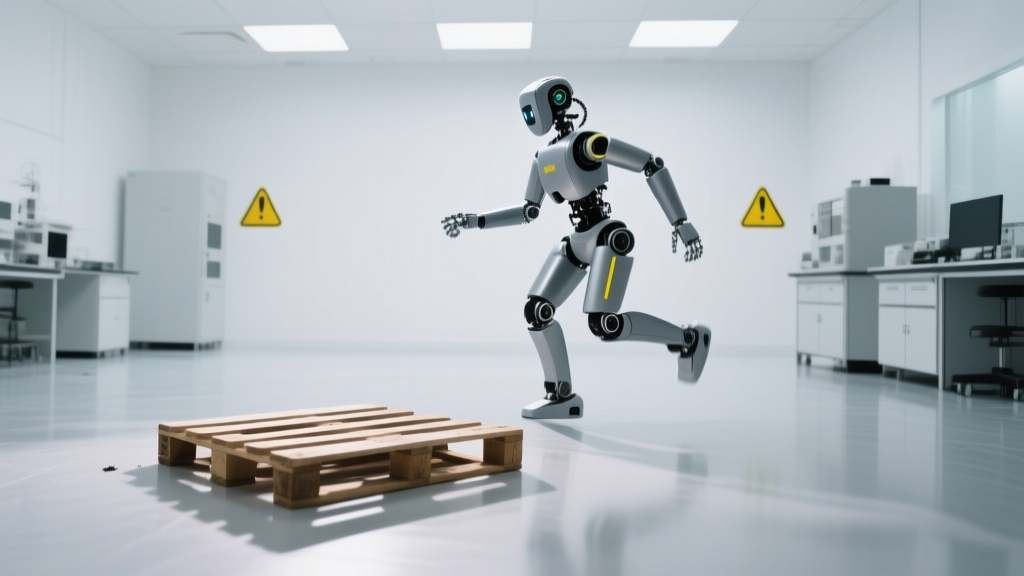
A Unitree humanoid robot executing a smooth, high-frame-rate motion demo in a clean, white-lit lab environment, but a single stray wooden pallet lies📷 Photo by Tech&Space
- ★Real-world vs. lab-grade dataset tradeoffs
- ★Humanoid payload limits remain unaddressed
- ★Researchers, not industries, are the primary users
Unitree Robotics’ latest open-source real-robot dataset for humanoid platforms arrives with the usual fanfare—high-frame-rate demos, fluid motions, and a promise of "high-quality" data. But the critical question isn’t whether the data looks impressive in a controlled YouTube clip; it’s whether it survives the transition from a choreographed lab environment to, say, a warehouse floor with uneven lighting, stray pallets, and a battery life that doesn’t align with shift changes.
The dataset’s value proposition hinges on its claim to be "real-robot" data, not simulations. That’s a meaningful distinction for researchers training models on legged locomotion or dynamic balance—but the term "real" here is relative. Early adopters in the r/singularity community note the dataset’s utility for academic benchmarks, yet industrial players remain silent. That’s telling: when the primary audience is grad students, not logistics managers, the deployment ceiling is already visible.
Unitree’s hardware constraints further narrow the use case. Their H1 humanoid—the likely data source—tops out at a 30kg payload and 1.8m/s walking speed, with battery life measured in minutes under load. Those specs don’t just limit tasks; they redefine what counts as a "real-world" scenario. A dataset trained on a robot that can’t carry a toolbox or last a full work cycle is, by definition, a research tool—not a deployment blueprint.
The gap between a polished dataset release and actual field deployment
The marketing framing of "high-quality" data also warrants scrutiny. Quality here likely refers to sensor fidelity and motion smoothness, not robustness under edge cases. Real-world deployment demands datasets that account for slippery surfaces, sudden obstacles, or the chaotic physics of a dropped object—none of which are highlighted in Unitree’s promo. The r/Sino thread’s lukewarm reception (10 upvotes) suggests even enthusiasts see the gap: this is a step forward for labs, not factories.
Scale-up friction emerges in certification and reliability. Humanoid robots in industrial settings require ISO 10218 compliance for collaborative operations—a process that demands thousands of hours of failure-mode testing. Unitree’s dataset, while useful for algorithm training, doesn’t address the harder problem: proving a robot won’t topple into a human when a motor glitches. That’s why Amazon’s warehouse robots are still wheeled and caged, not bipedal and free-roaming.
The most plausible near-term use case? Universities and startups fine-tuning control policies before they hit the same hardware walls. For everyone else, this is another reminder: the distance between a dataset release and a deployable robot isn’t measured in code commits, but in mean time between failures and liability waivers.
How many "high-quality" datasets does it take to train a robot that can work a 10-hour shift without a safety cage? The answer isn’t in the data—it’s in the hardware specs Unitree (and everyone else) still isn’t talking about.