
OpenSeeker’s open gambit: Can 11K data points break AI’s data monopoly?
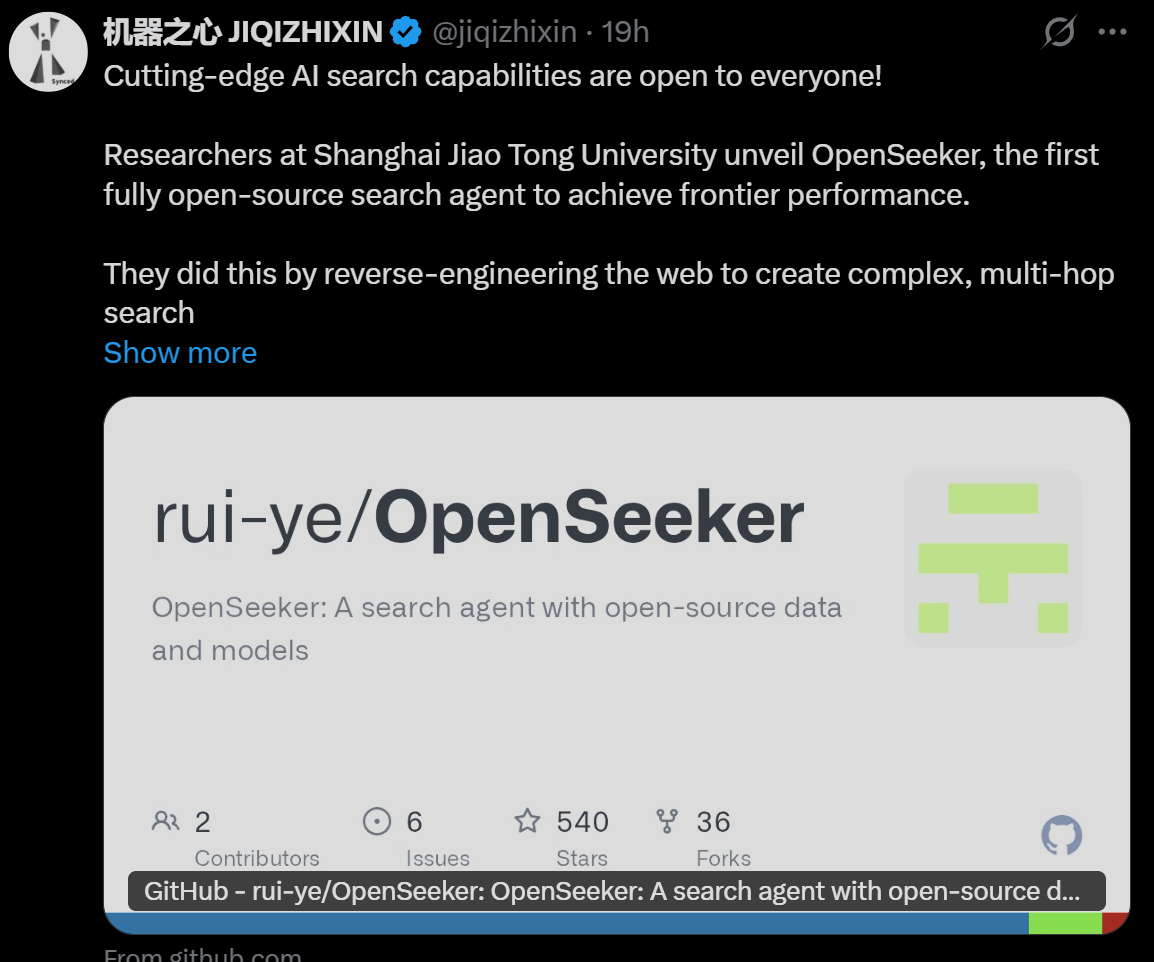
OpenSeeker’s open gambit: Can 11K data points break AI’s data monopoly?📷 Published: Apr 15, 2026 at 10:18 UTC
- ★11,700 training points rival Alibaba’s models
- ★Open-source AI search with full transparency
- ★Single training run challenges efficiency norms
OpenSeeker isn’t the first AI search agent to promise disruption, but it might be the first to do so with a spreadsheet’s worth of data. Just 11,700 training points—roughly the size of a mid-sized academic dataset—propelled the open-source project to performance levels comparable to Alibaba’s proprietary models. That’s not just lean; it’s borderline heretical in an industry where data hoarding is the default.
The project’s full transparency—code, model weights, and training data—is equally rare. Most open-source AI efforts stop at model releases, treating data as a proprietary moat. OpenSeeker flips the script, but the question lingers: is this a technical breakthrough or a cleverly packaged demo? The single training run claim suggests efficiency, but real-world search agents often require iterative fine-tuning to handle edge cases.
What’s genuinely new here isn’t the performance—it’s the audacity of the bet. By open-sourcing everything, OpenSeeker forces a reckoning: if high-quality results can come from minimal data, what’s stopping competitors from doing the same? The answer may lie in the GitHub activity, where early reactions range from cautious optimism to skepticism about scalability.

The real test isn’t benchmarks—it’s whether openness scales beyond demos📷 Published: Apr 15, 2026 at 10:18 UTC
The real test isn’t benchmarks—it’s whether openness scales beyond demos
The industry implications are sharp. Proprietary search agents like Alibaba’s and Google’s rely on data monopolies to justify their black-box models. OpenSeeker’s approach threatens that logic, but only if it proves repeatable. Early adopters are already testing the model against real-world queries, with mixed results—some praise its efficiency, while others point to gaps in contextual understanding.
For developers, the project is a double-edged sword. On one hand, it lowers the barrier to entry for building AI search tools. On the other, it exposes the fragility of benchmarks: a single training run might impress in a demo, but production deployments demand robustness that demos rarely address. The lack of detailed competitive metrics—how OpenSeeker stacks up against Alibaba’s latest, for example—leaves room for doubt.
The real signal here isn’t the performance itself, but the shift in narrative. OpenSeeker isn’t just another AI model; it’s a provocation. If the open-source community can replicate its results at scale, it could force a reckoning in how AI search is built—and who controls the data that powers it.
For businesses, the takeaway is clear: proprietary data moats are no longer the only path to competitive AI. The challenge now is whether OpenSeeker’s approach can scale beyond demos—or if it’s destined to join the graveyard of ‘promising but unproven’ open-source projects.