
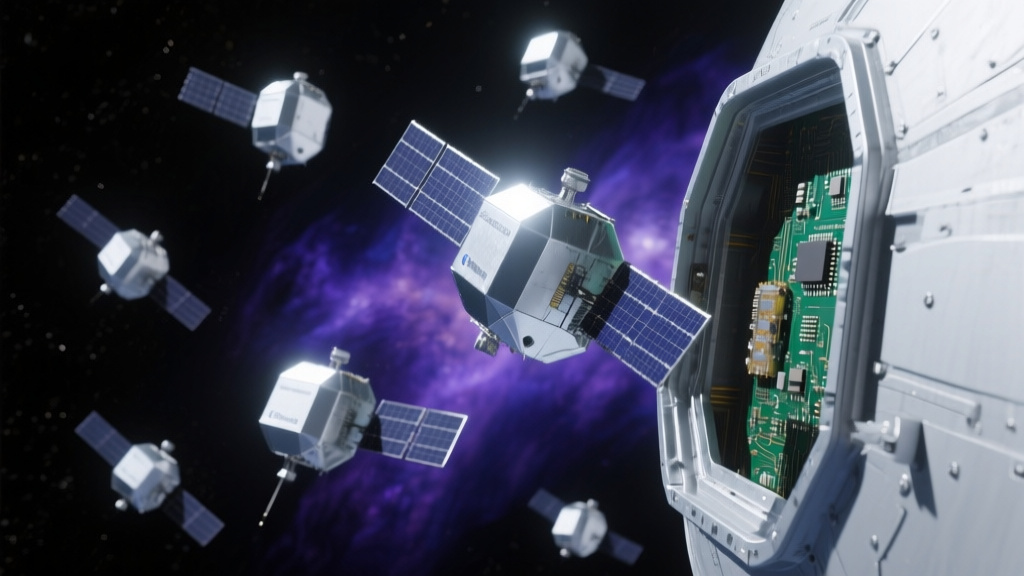
Eight small silver CubeSats from ESA's InCubed program dispersing in deep black orbital space, their metallic solar panels catching sharp volumetric📷 Photo by Tech&Space
- ★Eight CubeSats and one ESA payload now in orbit
- ★Testing real-time data transfer for disaster response
- ★Part of ESA’s broader [InCubed](https://incubed.esa.int/) commercialization push
The European Space Agency’s latest deployment isn’t just another cluster of satellites—it’s a calculated step toward solving one of space’s most persistent bottlenecks: how to get the right data to the right place before it’s too late. Eight CubeSats and a single hosted payload, all launched under ESA’s InCubed program, are now orbiting Earth with a singular mission: to stress-test optimized data transfer methods that could slash delays in everything from climate monitoring to emergency response.
The payloads aren’t experimental in the abstract. According to ESA’s technical briefings, they’re designed to validate protocols for prioritizing time-sensitive data—like flood warnings or wildfire tracking—while filtering out less urgent transmissions. Early signals suggest the system could reduce latency by up to 40% in high-demand scenarios, though ESA has yet to release peer-reviewed validation.
This isn’t a standalone effort. The missions align with ESA’s Space for 5G initiative, which treats low-Earth orbit as a testbed for integrating satellite networks with terrestrial 5G. The CubeSats themselves, built by consortia including AAC Clyde Space and Open Cosmos, are deliberately modest in scale—each roughly the size of a shoebox—but their collective ambition is anything but.

ESA’s CubeSats redefine how space data reaches Earth📷 Photo by Tech&Space
The confirmation that changes the timeline for Earth observation
The scientific significance lies in the mundane: reliability over spectacle. Current Earth observation systems often dump raw data to ground stations in bulk, creating delays as analysts sift through terabytes of irrelevant imagery. These missions are testing onboard processing—letting satellites pre-sort data before transmission. For climate scientists tracking Arctic ice melt or aid agencies coordinating disaster relief, the difference between a 6-hour delay and near-real-time updates isn’t academic.
What’s still unproven is whether these optimizations can scale. The CubeSats’ laser communication payloads, for instance, require precise alignment with ground receivers—a challenge in dynamic orbital conditions. ESA’s Optical Ground Station in Tenerife will serve as the primary testbed, but until the missions complete their 6–12 month demonstration phase, claims about ‘revolutionary’ speed remain speculative.
The real bottleneck may not be where the marketing points. While ESA highlights the potential for ‘life-saving data,’ the harder question is whether commercial operators—who dominate the CubeSat market—will adopt these standards. Without industry buy-in, even proven optimizations risk becoming another niche capability in an already fragmented orbital ecosystem.