
Claude’s Legal Limbo: Who Decides AI’s Supply Chain Risk?
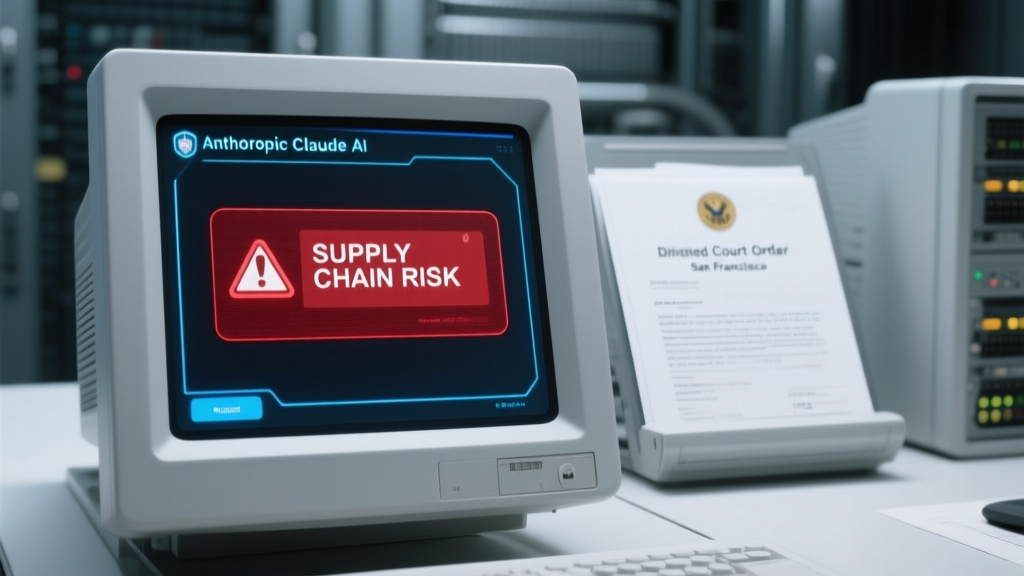
Claude’s Legal Limbo: Who Decides AI’s Supply Chain Risk?📷 Published: Apr 9, 2026 at 24:45 UTC
- ★Pentagon labels Claude a supply chain risk
- ★California court calls defense move 'bad faith'
- ★Competing rulings leave Anthropic in legal gray zone
Anthropic’s Claude AI model is caught in a regulatory no-man’s-land after two U.S. courts delivered opposite verdicts on the same question: Is the model a supply chain risk? On Wednesday, a Washington appeals court upheld the Pentagon’s designation, which restricts Claude’s use in defense procurement. That ruling directly conflicts with a lower court’s decision in San Francisco, which called the Pentagon’s move 'bad faith' and ordered the label revoked. The split leaves Anthropic—and its customers—in limbo, with no clear path to resolution.
The case highlights a broader tension in AI governance: Who gets to define risk when courts and federal agencies disagree? The Pentagon’s stance hinges on unpublicized assessments of Claude’s potential vulnerabilities, while the California court cited procedural flaws in the Defense Department’s decision-making. For Anthropic, the stakes are high—supply chain labels can throttle enterprise adoption, particularly in regulated sectors like defense and finance. Wired first reported the conflicting rulings, but the underlying arguments remain sealed, leaving observers to parse the implications from legal filings alone.
Beyond the immediate legal wrangling, the case underscores how AI’s supply chain risks are becoming a proxy for geopolitical and commercial battles. The Pentagon’s label implies a broader concern about open-source dependencies or foreign influence, even if the specifics are redacted. Meanwhile, Anthropic’s competitors—including closed-source models from OpenAI and Google—face no such scrutiny, despite similar architectures. The discrepancy raises questions about whether the label is about security or market protection.
The gap between national security labels and judicial oversight📷 Published: Apr 9, 2026 at 24:45 UTC
The gap between national security labels and judicial oversight
The technical community’s reaction has been muted, with most developers treating the legal drama as a sideshow to Claude’s actual performance. GitHub activity around Anthropic’s repositories remains steady, suggesting no immediate exodus of contributors or users. However, enterprise customers may hesitate to integrate Claude while its compliance status is unresolved, particularly in sectors like aerospace or government contracting where supply chain audits are rigorous. Anthropic’s forum has seen a spike in threads about alternative compliance pathways, but no workarounds have gained traction.
The real losers here may be smaller AI startups lacking Anthropic’s legal firepower. A single Pentagon label can deter investors, customers, and partners, creating a chilling effect that disproportionately impacts open-source projects. The case also sets a precedent: If federal agencies can unilaterally label AI models as risks without judicial oversight, the door opens for arbitrary designations that could reshape the entire industry. For now, Anthropic’s only recourse is to appeal—or wait for another court to break the deadlock.
The hype around Claude’s capabilities hasn’t wavered, but the legal saga reveals a growing reality gap: AI’s deployment isn’t just about benchmarks or demos. It’s about navigating a patchwork of regulations, interpretations, and bureaucratic whims. Until the courts or Congress clarify the rules, companies will operate in the shadow of competing authorities—each with its own definition of what makes an AI system 'safe.'
In other words, Claude’s legal limbo is less about the model’s actual risk and more about who gets to decide what risk even means—a question that may outlast the technology itself.